About
Meta
This page exists to set the stage or provide context. You can think of it as a conceptual intro to an operations manual.
This is not a bio. I loathe bios. Makes me think about these corpotrones that start a presentation by saying:
My name is Donald Disposable, I’ve been working at E-Corp for $wayTooMany years as a glorified paper pusher and or doormat. In my free time I like to do an unspecified – yet bland – kind of physical activity.
There’s just something profane and deficient in trying to cast a persona into an information dense-ish short form to provide a false sense of familiarity. Unless you really do it right. I won’t.
I would have written it shorter, but did not have the time.
Prepare
I would imagine this about page is supposed to show off mostly your professional side and not all that embodies your humanity.
~ Matilda Dugan
I believe it doesn’t work like that. We live in the age of ubiquitous lenses and amplifiers. In the age when countless machines multiply and enforce someone’s will billion times a second. Machines rented on demand, by the bushel. We live in interesting times.
That’s why individuals and their interactions matter, now, more than ever. That’s why it’s so intertwined.
Subsection
Finally, this page is a collection of sections with subsections. There isn’t a proper order to the sections (and subsections are often rather unordered and just linearized for the sake of the medium) though I’ve aimed for the least wrong one on average. In the future I’ll convert it to a standard mind map format, poetry will be made by everyone and there’ll be emus in the zone.
Intro
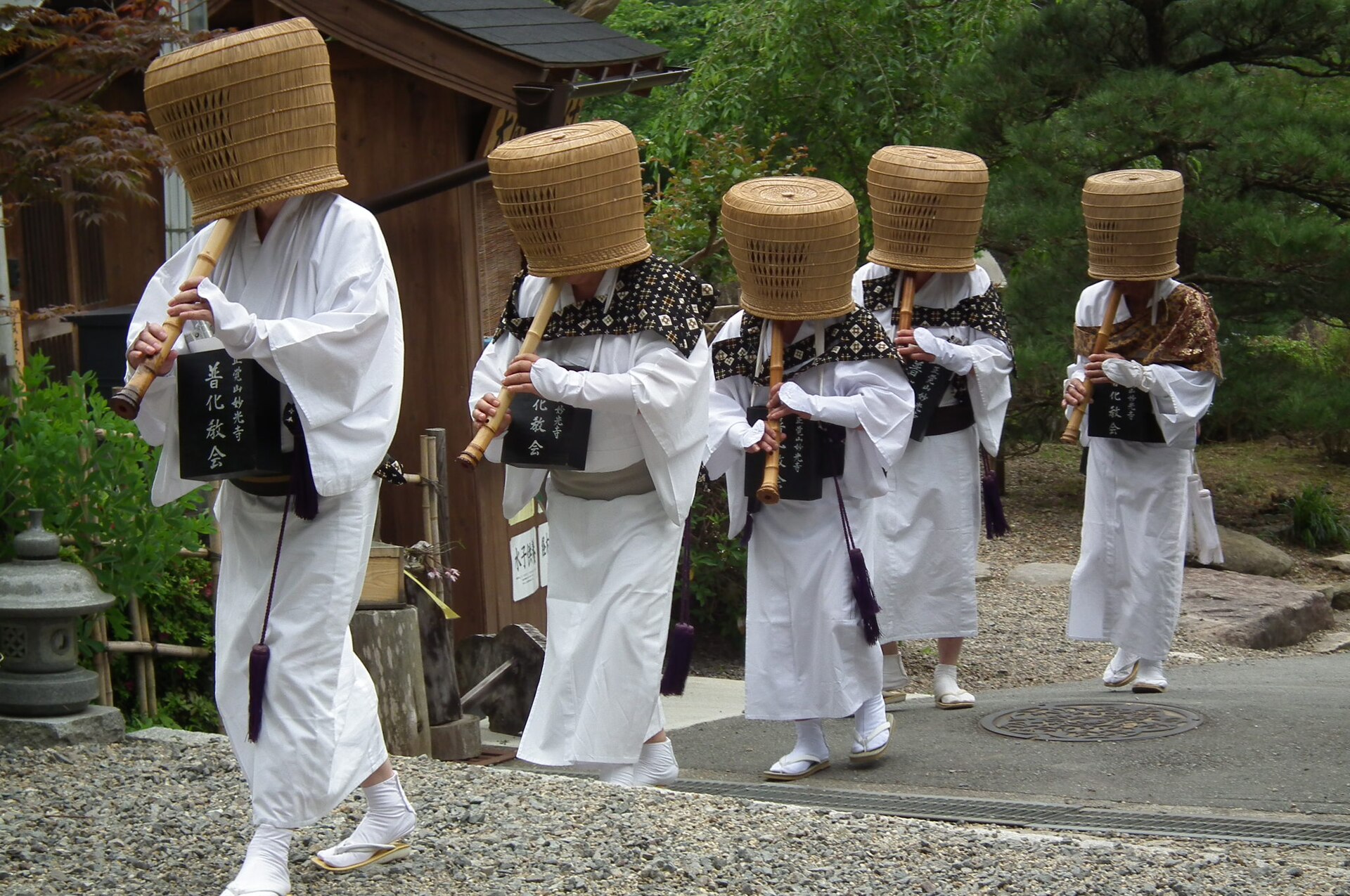
The komusō - monks of empty, priests of nothingness. They came from rags and from nobility alike. By the order of shōguns they were granted the right of unresticted travel. They had no faces, no names – no identity. Fungible in their flute-induced trance?
I’m the second guy from the left.
Or am I?
Hello, delicious friend. Now that your tabula has been rasa I invite you on a journey.
About personality traits
Personality traits seems like a reasonable foundation since they’re fairly stable and tend to explain a lot.
Or maybe you have been somewhat troubled by how this peculiar term personality […] has become a repository of so many adjectives - one that violates Aristotle’s cardinal metaphysical rule against reducing a substance to its properties.
~ Sorting the Self, Christopher Yates
I’m referring to the Big 5 or O.C.E.A.N. model, since it’s the crown jewel of modern psychometry. In fact all other models that depend on self-reporting are a subset of Big 5 done with varying levels of quality.
In this section some words, like Extroversion, although have a meaning in the everyday language, should rather be interpreted as precise terms from said model. I’ll attempt to capitalise them to further denote that. Equivocation is the mind-killer.
The quotes in this section, unless stated otherwise, are from Understand Myself report of yours truly and the adjectives (“high”, etc.) denote “relative to a [non-existing] perfectly average human”. I aimed to pick out the fragments that apply to me the most.
I’d try to bring to your attention the lowlights as well - trait manifestations are neither good nor bad, they’re a particular trade-off.
High Extroversion
People with high levels of extraversion are comparatively enthusiastic, talkative, assertive in social situations, and gregarious. […]. They tend to speak first and most often in meetings. They can be captivating and convincing. They will often be the first to act. […] They are positive and optimistic. They warm up quickly to other people.
although,
People high in extraversion are more dominant in social situations, particularly if they are also low in agreeableness. Less agreeable extraverts tend to be self-centered. […] They don’t generally wait for others to lead the way.
In other words: I have a strong presence and bias for action, maybe not this strong… yet? I laughed while reading about it though.
I may take charge when needed (preferable: flat structures / rotating leadership). And “when needed” is when I find the current charge lacking.
This means I perform best with either a lot of freedom, autonomy and resources at my disposal (so much can depend upon a wheel barrow) or a strong, competent, respectful leader. Ideally both.
I have 0 problem with talking to people, talking to people on the phone (I’m aware that some folks hate that), talking to a lot of people at once (see my talks!). Also: I need to talk to people. Participate. Interact.
High Neuroticism
I have it on good authority, from different sources that it’s not immediately obvious that I score high on trait Neuroticism.
High levels of neuroticism may interfere with both success and satisfaction in relationships and career. […] They are also more likely to be unhappy, anxious and irritable when just thinking or remembering, and when they encounter a genuine problem. […] They tend to experience somewhat higher levels of doubt and worry, become embarrassed a bit more easily, are self-conscious and may get discouraged more rapidly in the face of threat and punishment.
Seems awful, right? Well, check this out:
People with high levels of neuroticism are more likely to think that things have gone wrong in the past, are going wrong now, and will continue to go wrong into the future.
Now that’s pretty useful! Though this gift of sight comes at terrible price. I mean it in a sense, which no vulgarity, no humor, no overstatement can quite extinguish.
They can be stirred up and upset and, once angry or irritated, take a longer than average time to calm down. They can be argumentative and lose their composure.
In practice I’m quite good at handling short-lived, concrete stressful situations (think: fire). My time to recover after reacting to disturbing event might be longer than average though. I hate perpetual vague sense of something’s-not-right though. My working theory is that my negative emotion baseline is elevated so a spike is not as disturbing by comparison, yet and additional constant effect is just too much.
Individuals high in volatility [an aspect of neuroticism] tend to vary in their mood.
Sure, whatever.
Brief intermission
Let me interject for a moment. What you guys are referring to as Linux, is in fact, GNU/Linux… You may be reasonably confused at this point. I’ll go on more about it at the end. Doesn’t positive emotion mean no negative emotions and vice versa? Well, no.
Being high in scores of positive emotion is generally an element of the independent trait of extraversion. Neurotic extraverts, for example, would experience high levels of both positive and negative emotional states, a kind of “emotional roller coaster”.
~ Wikipedia backed by a journal
Is it as fun as it sounds, especially when you add low Agreeableness to the mix? Yes!
Moderately high Industriousness (Conscientiousness)
I’m explicitly split the subdimensions of conscientiousness - they seem to make more sense this way, although I see how they’re connected.
Moderately industrious people […] are generally quite dutiful and tend not to put things off or mess them up. They also tend to finish what they start, pretty much on schedule. Moderately industrious people have some genuine interest in considering how to accomplish more in less time, with fewer resources, and can focus consistently on the task at hand. They don’t live to work, however, and do not always have to be doing something useful.
In a room of 100 people around 30 would be more industrious than I am. So I’m not the best grinder, but no slacker either.
Moderately industrious people are quite likely to judge shirkers or people who are incompetent in a negative manner.
Indeed.
Very high Orderliness (Conscientiousness)
Very orderly people are uncommonly disturbed and disgusted by mess and chaos. They keep everything neat, tidy and organized. […] They make and stick to schedules. They like everything exactly where it should be – and very much want to make sure that everything stays where it belongs. They are detail-oriented to a degree that can border on the obsessive. They can be very good at ensuring that complex sensitive processes are managed properly and carefully.
Fair.
They are strikingly rule-abiding, and insist that rules are scrupulously observed. They want to do things by the book.
Caveat: the rules that make sense.
They require and crave routine and predictability. […]
Well now, inflexible much? Au contraire! maybe a bit. I wouldn’t say it’s exactly “craving” routine, it’s about safety – if there’s a method to the madness it cannot hurt me.
Exceptionally low Agreeableness
Agreeableness is a very complex trait, with marked positive and negative elements all along its distribution. Because of this, higher scores and lower scores need to be explained at the same time.
People high in agreeableness are nice: compliant, nurturing, kind, naively trusting and conciliatory. However, because of their tendency to avoid conflict, they often dissemble and hide what they think.
People low in agreeableness are not so nice: stubborn, dominant, harsh, skeptical, competitive and, in the extreme, even predatory. However, they tend to be straightforward, even blunt, so you know where they stand.
If this sounds hard-core to you - it’s not as extreme, but no picnic either. My Neuroticism and Orderliness keeps me in check more often than not - so don’t expect tantrums or scenes. I’ll reiterate - this is not agreeableness as in “getting along”, this is Agreeableness the trait.
As mentioned earlier - the traits are relative to the “average”. There are bounds on a person that functions in a society - too agreeable will be clinically codependent, not agreeable enough – end up in jail. What I mean is that the differences aren’t that staggering and you’ll not see immediately low Agreeableness markers. In fact an appearance study I did (n=6) supports this claim.
My “nice” behaviours may be just coming from a different place than the hyperuranic niceness.
They […] will happily sacrifice peace and harmony to make a point or (if conscientious) to get things done. People may find them painfully straightforward and blunt.
In other words:
Because of their tendency to engage in conflict, at a moment’s notice, people exceptionally low in agreeableness do not sacrifice medium to long-term stability and functionality for the sake of short-term peace. They let you know exactly what they think, when they think it, whether you want to know it or not. […] People exceptionally low in agreeableness are therefore less likely to suffer from resentment or to harbour invisible anger.
Better.
They make certain their own needs and interests are attended to, and are extraordinarily unwilling to sacrifice for the sake of other people’s comfort.
What if our interest align though? What if my success is contingent on your success?
Very high Openness
People with very high levels of openness are extremely likely to be characterized by others as uncommonly smart, creative, exploratory, intelligent and visionary. They are strikingly interested in learning, and are constantly acquiring new abilities and skills. They are very curious and exploratory. They are very interested in abstract thinking, philosophy, and the meaning of belief systems and ideologies. […] They are very imaginative, and love to daydream and reflect on things.
Oh, stop, you’re making me blush. Have you noticed “hyperuranic” though?
People very high in openness can see old things in strikingly new ways. They can formulate any single problem in an uncommonly diverse range of ways, and can generate an atypically large number of problem-solving solutions. […] They are very radical thinkers. They shake things up, particularly if they are also disagreeable and assertive.
I’ve seen worlds where crypto cats own their crypto hats!
They will continually seek change, often to make things better, but also just for the sake of change. They require an outlet for their creative ability, or they cannot thrive.
There are a lot of things that can be tinkered with and have I mentioned that everything is interesting?
They can be impractical […]
And needlessly theatrical.
And redundant. And repetitive.
And redundant. And repetitive.
And then the dragons arrived.
On systems and character
Knowing many stories is wisdom.
Knowing no stories is ignorance.
Knowing only one story is death.
~ Past Grand Archdruid John Michael Greer
I’ve told you a few stories, but what you interact with will be a system. Alan Kay has put it beautifully in this keynote. A person is a system, more than the sum of parts for the parts have relationships with regards to one aother. In fact it’s sometimes useful to think about a persona as a collection of dreadfully distinct subpersonalities.
When individuals are extraverted and conscientious, they are more productive than if they are introverted and conscientious.
The stories will twist and tangle in a myriad of colours and swarm of shapes. In my case apply one additional spin to the resulting image. I consider myself not only a special snowflake, but a also particularly complex one.
I exhibit neurodivergency markers and treat my own sanity as an elaborate balancing act rather than a given. This is how you find madness in methods and method in madness.
Character is the ability to temporaily act outside of or beyond one’s personality. We are not here, on this plane, merely to satisfy every impulse of the body, nor to drift with each passing memetic current. An animal reacts. A person is cappable of suspending reaction. Like any cognitive technology [psychotechnology], it can be developed. I try to cultivate my character.
About values
Values are:
- actionable
- comparative (X > Y is a value, X on it’s own is just a wish),
- predecisions
1. Truth
2. Freedom
3. Quality
There are countless ways to put it. Even though the design on the left did the job it was worth the considerable [compared to the rest of the project] additional effort to achieve the design on the right
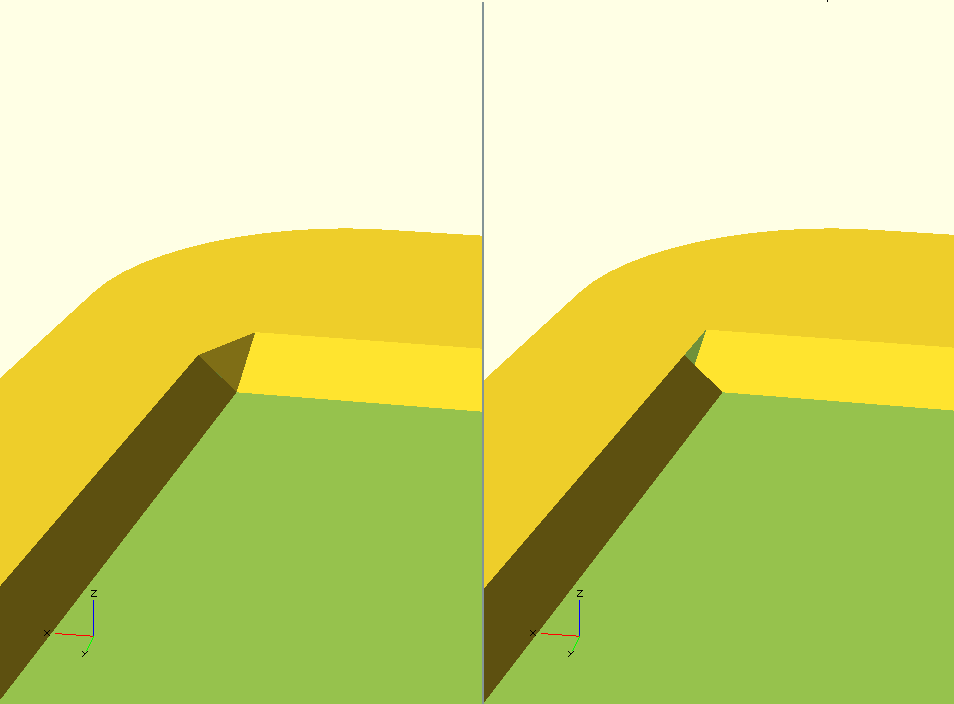 (see the full story)
4. Style
About profession and specialisation
Specialization is for insects.
~ Robert Heinlein
I’ve been asked on a number of occasions: How many years of experience do you have flopnaxing the ropjar?
Now it is demanded you are specialist first, generalist second, especially since programming is perceived as this “super hard thing” to learn that most people figure it impossible to know more than a few things at once. While developers understand it isn’t, people recruiting them believe such stuff […].
~ hn comment
About what can I do for you
I’m a shaman. We live in a capitalist, nominally meritocratic, somewhat classless, post-industrial society.
How do the two connect?
Shamans are a cross-cultural phenomenon broadly occupied with acquisition of insight through the use of psychotechnologies. “Cross-cultural” means that the tribes without shamans were wiped out by the ones that had them.
Shamans were there to not only generate the insight but also it to actually reach a person. There are written records of native people of Australia ignoring HMS Endeavour when it first came, because it was so radically different from anything they’ve ever seen.
More keywords that resonate with me: research, high leverage, open-ended, prototype, interactive, participatory, meaning, system, learning, knowledge, cognitive, stories, myth, finance
What does that mean?
~ Julia
If you don’t get the above (some will, some won’t - no worries) let’s try this way: I solve problems. This is a gross oversimplification, but may be easier to work with. We need to talk markets at this point.
There are many general problem solvers on the market. Some have access to vast networks far exceeding mine. Some will be far more efficient at certain classes of problems. Some will be cheaper. Every one of them will have their limitations though. I do too. It might just happen that for a particular endeavour my limitations are the only acceptable ones.
Entering into the realm of probabilities: I think I might help you the most with idiosyncratic problems. Problems that are not very well defined. Where the way forward is by no means obvious. Heavily constrained solution space. Weird. Abstract. Dissipative systems. Because sometimes you just need to
Make it personal.
~ Quellcrist Falconer
I have some expertise in programming computers. I can think; and write what I think; and speak what I wrote. I know how to do a few other things. Apparently I’m an engineer after all. And will learn whatever is necessary to get the job done. Fast. I hope by now you see know how missing the point “what exactly do you do” is. It just happened that so far I’ve used computers the most.
Never mind computers. Ira, the most sophisticated machine the human mind can build has in it the limitations of the human mind. Anyone who thinks otherwise does not understand the Second Law of Thermodynamics.
~ Lazarus Long
Going forward it’s more of a loose collection of notes rather than a coherent page - work in process, though
Strong opinions weakly held
- Important people should wear some kind of accessory designating their status. Like fancy hats. CEOs should wear fancy hats!
- Fairness is treating different people differently
- I can do an infinite amount of no work in no time at all (even more true in the age of LLMs)
About ethics - what I won’t do for you
I lean a bit more towards consequentionalism than deontology, however I don’t [and can’t] consider impact beyond second order effects. Example: making people smoke more will cause them harm and not much good otherwise. Making telecommunications easier / cheaper / … might make it possible for some people to make other people smoke more. Nothing I can do about it and the improved communications will benefit other casues as well.
- Guns don’t kill people. People kill people.
- Except for biological weapons – can we please don’t?
- There are things worse than death, because when you’re dead you’re still you. I refuse to participate in damaging the souls of individual (and by extension the humanity) through dopamine fracking or other means of cognitive warfare. Adversarial algorithmic feeds are means of mass destruction.
- I’m ok with working on infrastructure for a gambling or porn outlet, but not on making them more adictive
- Willingly adpoting dark patterns or asking me to adopt them will be met with a response. Although I’m aware that sometime we set up crappy systems accidentally – never attribute to malice what can be explained by stupidity.
- The bar is raised when your service is part of a de facto oligopoly. Litmus test: would someone be considered a weirdo for not having / using it? Example: smartphone, WhatsApp
- Goverments already know too much about their people
Would you work for a company that legally minimizes taxes but contributes little to public services? Gladly
- I will not create probabilistic systems that decide someone’s fate with no practical human-in-the-loop recourse if the individual disagrees with the decision
Would you work on software that helps insurers price health insurance? Sure
- Cryptocurrencies and the likes are voluntary transactions at the current fair market price
Would you build software that measures warehouse-worker productivity in real time? Nope, butlerian jihad rings a bell?
- If it’s legal and not wrong then it’s probably all right
- Throwing money at an ethics problem is a noop
Open questions
- Would you develop tools that allow parents to monitor their children?
- Would you develop tools that allow spouses to monitor each other?
About what next
I’ve been thinking about this stuff very seriously for over a decade, and I love that you’re the first person who’s really let me implement it.
~ Sean Coates on Matter’s privacy approach
When I let go of what I am, I become what I might be. ~ Lao Tzu
v- TODO: a page like this https://chelseatroy.com/are-you-hiring/ v- TODO: approach to work https://alexanderobenauer.com/work/ https://www.leanessays.com/2019/04/what-if-your-team-wrote-code-for-737.html?m=1 gardener, but also an engineer xD http://chrisaitchison.com/2011/05/03/you-are-not-a-software-engineer/ also explain: raven ring
v- TODO: inspiration of sorts? https://aliceininternet.medium.com/who-am-i-what-do-i-do-1e496c4222cf
Interaction points, np: zinzino
https://terriblesoftware.org/2025/07/18/why-most-feedback-shouldnt-exist/
Also: I’m unbelievably bad at enumerating past events in a chronological order. It’s just how my mind works. If the past is connected to something it is there - it’s just doesn’t stand quite well on it’s own for me. So I totally abhor the practice of status reports. I’ve got no idea “what’s up”. I can use tools to probably reconstruct it. Don’t love it.